




 Energy



More relaxing, especially in traffic
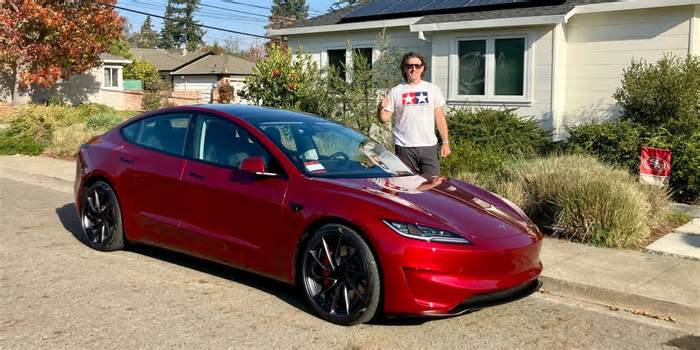
Let's get this out of the way first: This is one of the best cars I've ever driven. On and off for over 20 years, I have test-driven cars from Hummers to Porsches to Alfa Romeos. The Model 3 Performance has incredible steering, high build quality, and incredible speed, for a lot less money than a BMW M4. It's a great deal and I love it.
In early January, switching on FSD was a surprise at first. It handled way more situations than I expected — basically everything on most trips.
Driving in traffic, with a destination punched into Tesla's onboard screen, is less stressful than handling stop-and-go congestion yourself and trying to decide which turn to take next. It's a new, slightly more relaxing experience. I get to my destination in a better mood.
Tesla FSD always comes to a full stop at stop signs. Obviously, I do too. But maybe I don't? This was annoying at first, but now I don't notice, and it's safer. I thought I would lose time, but really, there's no difference. What started as an irritation became a reminder of how easily humans normalize cutting corners when driving themselves.
The FSD is a more efficient driver. It uses less battery power than I do driving the car. I know this because I look at the onboard map, which predicts the battery level upon arrival. Once I switch to FSD, that prediction drops and stays lower once I arrive.
Potholes and disengagements
Pothole avoidance, please! My Tesla in FSD drives straight over most potholes on the road. I try to (carefully!) avoid them while driving myself. Is this why some Tesla owners say they have to replace their tires so often?
I disengaged FSD in San Francisco a few months ago. There was a car parked on the side of a thin side road. I knew I could squeeze around it, but Tesla FSD just sat there. So I took over, drove around, and then restarted FSD.
I disengaged another time on Highway 80, going from Silicon Valley to Lake Tahoe with my wife. We were in FSD (Chill mode) in the slow lane. Traffic built up ahead, and the faster lanes started backing up. Another car darted into our lane, right in front of us. We screamed, and I grabbed the wheel. Maybe FSD would have handled it, but I wasn't willing to find out.
Speaking of lanes: In Chill mode, FSD stays in the slow lane, and it's slow to move across when a highway intersection is approaching. This gets me stuck behind cars merging onto the highway.
When I drive myself, I get over into the outside lanes before this stuff happens. I know a few blocks in advance that something is going to get snarled, so I adjust early. Tesla FSD doesn't do that in Chill mode. So, we have to slow down and get into complex merge situations. I suspect being in other FSD modes, such as "Hurry" mode, would mean my Tesla drives in the faster, outer lanes of the highway.
A test and a change of heart
I was impressed during the first two to three months of using FSD. When my free trial ended in June, I thought I would probably start paying $99 a month for this technology. And I don't even drive that much. I bought this car to drive a fast sports car. Now, I barely drive it.
That paragraph above was the thrust of the story I planned to write earlier this year.
Then, my colleague Lloyd Lee and I tested Tesla FSD against Waymo in San Francisco on May 1. You can read all about that here. TLDR: We ran a red light while in my Tesla's FSD mode. Waymo refused to go that specific route, suggesting that Waymo's software system can't handle that specific intersection either. However, I was shocked by the experience.
Walker Smith says there's "a huge difference between running a red light at an intersection and proactively avoiding the intersection."
Related stories
Please first to comment



Stay Connected
Tweets by elonmuskTo get the latest tweets please make sure you are logged in on X on this browser.