




 Energy




News Reporting
Based on facts, either observed and verified firsthand by the reporter, or reported and verified from knowledgeable sources.
The Trust Project What is this?
GRAND FORKS — To Robert Kraus’s recollection, one thing Andrew Armacost said at the start of his presidency that he desired for the University of North Dakota was a satellite.
That wish is coming true, twofold.
ADVERTISEMENT
“We got to give credit to President Armacost,” said Kraus, dean of the John D. Odegard School of Aerospace Sciences. “He’s been supportive of everything that we’ve been doing to get to this point.”
Pablo de León, department chair and professor in the department of space studies, added, “so instead of one satellite, we’ll give him two.”
“And more to come,” Kraus replied.
The university will launch the first two satellites commissioned in North Dakota out of a SpaceX Falcon 9 rocket at 4:19 p.m., Saturday, June 21, out of the Vandenberg Space Force Base in California. The project, called the ROADS mission (Rendezvous and Operations for Autonomous Docking and Servicing), will deploy the satellites from the launch vehicle.
Once in orbit, the satellites will slowly drift apart, then perform rendezvous proximity operations and docking. Ronald Fevig, associate professor of space studies, said the two satellites, slightly larger than half-gallon milk cartons, will provide UND students with experiential learning opportunities, such as training on Doppler tracking — using radio signals to track satellites — and having a digital repeater for the amateur radio community.
“Those four are our primary objectives — docking, educational, tracking and communications,” Fevig said.
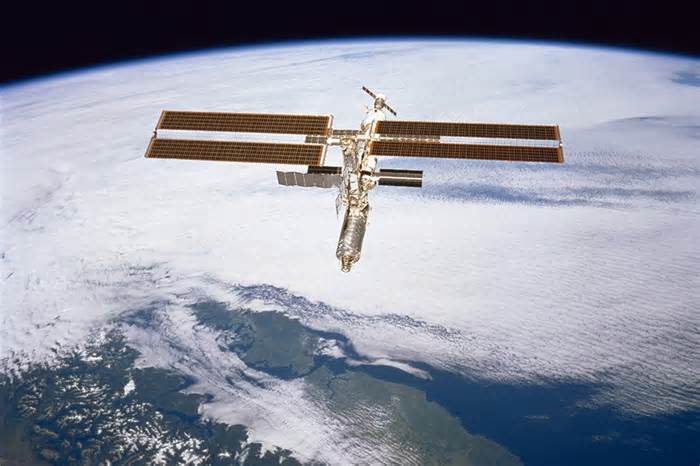
This isn’t the first time UND has had hardware in space, Fevig said. ISSAC, the International Space Station Agricultural Camera, designed, built and operated by UND students and faculty, was operated on board the International Space Station from 2011 to 2013, according to a UND webpage about the project.
ADVERTISEMENT
De León said the satellites will also attempt to dock with another satellite to refuel. Refueling is a complex process for satellites, he said.
“That opens an array of different possibilities, one of them being in the future probably refueling, which will be a critical technology that needs to be mastered in order to increase the time of operations of satellites in space,” he said.
The project was mainly funded by $4 million in appropriations from the North Dakota Legislature in the 2021 biennium. UND was given the funding for space and national security research, which the School of Aerospace Sciences used a small portion of to build a space operations classroom in Robin Hall. From there, De León found a company to collaborate with and develop the satellites — AVS USA, an engineering firm headquartered in New York.
The remainder of the school's portion of the funding went to the satellites, with UND providing some funding to cap it off. Students will be trained on how to operate the satellites.
Kraus said it has been difficult for universities to get satellites into space in the past. Because SpaceX launches two or three rockets a week and allows universities to put their projects on board, it has made the idea of launching a satellite more viable.
There has been additional funding given to UND for space and national security, which has been used to finish the national security corridor in the College of Engineering and Mines, Kruas said. The College of Engineering will move in to design and build its own satellites, which it will launch and the School of Aerospace Sciences will operate.
“We wanted to get something up, start using it, train people on how to do it, while Engineering is building their facilities to now design and build their own,” Kraus said. “It’s a very cross-discipline set of projects. And so we’re seeing more and more partnerships between the School of Aerospace Sciences, the College of Engineering and Mines, and then also physics and astrophysics and arts and sciences."
ADVERTISEMENT
Please first to comment



Stay Connected
Tweets by elonmuskTo get the latest tweets please make sure you are logged in on X on this browser.