





 Energy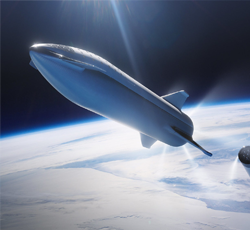





— SpaceX (@SpaceX) November 19, 2023
During this critical moment, the upper stage Starship successfully ignited its Raptor engines before detaching from the booster, which simultaneously powered down all but three of its engines. This coordination allowed the two stages to separate smoothly, with the booster executing a flip maneuver for its return to Earth, while the upper stage proceeded toward suborbital space.
However, the booster did not make it back successfully (it was supposed to splash down in the ocean). The Super Heavy exploded some 56 miles (90 kilometers) above the Gulf of Mexico, more than three and a half minutes into the flight. On a more positive note, “All 33 Raptor engines on the Super Heavy Booster started up successfully and, for the first time, completed a full-duration burn during ascent,” SpaceX said. At least six booster engines failed during the first demo in April.
A view of the booster after it exploded.
Photo: C&J Images
The reason behind the latest failure is still unclear, but it is possible that the hot-staging process placed excessive stress on the booster, triggering a chain of failures that culminated in its explosive demise. Following the stage separation, the Super Heavy executed a notably aggressive flip maneuver, which may have led to issues with relighting its Raptor engines, possibly the result of propellant sloshing or damage, as noted by the Orbital Index. Additionally, the Orbital Index highlighted that engines drawing tank pressurization gas instead of actual propellant are prone to highly destructive behavior. SpaceX now faces the challenge of identifying the root cause, which could lie in the hot-staging sequence or the hardware involved, or a combination of the two. Addressing these issues will be crucial for the company’s future missions.
Figuring out why the upper stage failed
Following stage separation, the upper stage, with its six Raptor engines working, continued on its journey toward its final destination—a hard splash down in the Pacific Ocean near Hawaii. Things appeared to be working nicely, until they weren’t; SpaceX lost contact with the rocket, and the explosion followed soon after.
“What we do believe right now is that the automated flight termination system on [the] second stage appears to have triggered very late in the burn, as we were headed downrange out over the Gulf of Mexico,” John Insprucker, SpaceX’s principal integration engineer, explained during the company’s live broadcast.
Starship flew to an altitude of approximately 93 miles (about 150 kilometers) and attained a velocity of around 14,913 miles per hour (nearly 24,000 kilometers per hour). This feat signified the first Starship to enter outer space and nearly achieve a full-duration burn, according to SpaceX.
“The flight test’s conclusion came when telemetry was lost near the end of second stage burn prior to engine cutoff after more than eight minutes of flight,” SpaceX explained. “The team verified a safe command destruct was appropriately triggered based on available vehicle performance data.”
The reason for the loss of signal has not yet been disclosed. Spaceflight enthusiast Scott Manley’s observant analysis suggests that the failure of the upper stage could have been caused by a leak in its oxygen tank. The upper stage’s failure at this phase of the mission came as a complete surprise to me, and I am very curious to learn the cause of this unexpected event.
Back to the FAA
SpaceX will need to procure a third Starship launch license from the Federal Aviation Administration. This necessary step is standard practice, given that the vehicle was lost. To move forward, SpaceX and the FAA will jointly conduct an investigation to uncover the primary cause of the mishap. The focus of the inquiry will be on identifying and rectifying the root cause of the anomalies encountered during the launch, with the goal of preventing similar incidents in future launches.
Despite the loss of the Starship vehicle, there were no reported injuries or damage to public property. Significantly, the Boca Chica launch facility’s newly installed infrastructure, including a water deluge system designed to handle the force of 33 Raptor engines, proved effective.
“The water-cooled flame deflector and other pad upgrades performed as expected, requiring minimal post-launch work to be ready for upcoming vehicle tests and the next integrated flight test,” SpaceX said.
Please first to comment



Stay Connected
Tweets by elonmuskTo get the latest tweets please make sure you are logged in on X on this browser.