




 Energy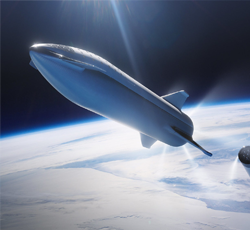



That was close! Driver narrowly avoids a cosmic calamity after a 'one-in-a-billion' METEORITE smashes into the windscreen of his Tesla

comments
An Australian driver narrowly avoided a cosmic calamity after a 'one-in-a-billion' meteorite smashed into his car windscreen.
Dr Andrew Melville-Smith, a vet from Whyalla, South Australia, was driving home from picking up his brand-new Tesla Model Y when a loud crash brought him to a halt.
'I thought we'd crashed,' said Dr Melville-Smith in a post on his clinic's website.
'I was in shock; I remember wiping glass particles from my face and being completely disoriented.'
Dr Melville-Smith initially had no idea what caused the sudden shock, and only began to suspect an extraterrestrial explanation when he found that the glass in his windscreen was melted.
Experts say that the odds of a meteor travelling from outer space to hit someone while they are driving are 'unimaginably unlikely'.
However, the South Australian Museum has now requested access to the car to investigate further and, hopefully, recover some fragments of the missing meteor.
If confirmed, this will be the first time in recorded history that a space rock has ever hit a moving vehicle.
Dr Andrew Melville-Smith, a vet from Whyalla, South Australia, may have narrowly avoided a cosmic calamity after his brand-new Tesla was hit by a meteorite
The impact is now being investigated by the South Australian Museum, which will be able to determine whether it really was caused by a meteorite
The shocking incident occurred at 21:00 local time on October 19, around 25 miles north (40 km) from the town of Port Germein.
Dr Melville-Smith was driving at 68 miles per hour (110 km/h), and the night was dark, calm, and clear without a hint of rain or lightning.
Suddenly, there was a loud crash, and the cabin of the car filled with white smoke and a burning smell.
Dr Melville-Smith looked around for anything that might have caused the collision, but there was no sign of anything or anybody nearby.
To make things more confusing, Tesla's onboard cameras didn't reveal anything that could have caused the damage.
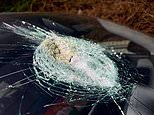
Upon stopping the car, the vet discovered that his windscreen had a massive crater where the glass appeared to have melted and sagged inwards, and was still warm to the touch.
Although it initially seemed absurd to think he had been struck by a meteorite, the fact that automotive glass melts at around 1,500°C (2,732°F) made him think twice.
That's when he decided to reach out to the scientists at the South Australian Museum.
Dr Melville-Smith was driving around 25 miles north (40 km) from the town of Port Germein when there was a sudden crash and the car filled with white smoke
Bizarrely, Dr Melville-Smith discovered that the crater in his windshield was partly melted and was still warm to the touch when he pulled over to investigate
Dr Kieran Meaney, Museum Minerals and Meteorites Collection Manager at the museum, says: 'My initial thought was, nah, there's no way this is going to be the real deal.
'We get a lot of meteorite inquiries at the Museum and most of the time they turn out to be a rock from earth that is doing a very good impersonation of a meteorite.'
However, just like Dr Melville-Smith, the mysterious melted glass made Dr Meaney think twice.
He says: 'Once I looked at all the details and the glass of his windscreen seems to have melted a little bit, and the acrylic layers in the glass have discolouration, almost like they've been burnt.
'It was certainly hit by something and it was something hot, and we don't have another good explanation for what else it could have been.'
When Dr Melville-Smith has the windscreen replaced, he plans to hand it over to the museum for further investigation.
If their analysis shows that a meteorite really was responsible, they will organise a field trip to try and recover the offending space rock.
However, not everyone is entirely convinced that a meteorite is really to blame.
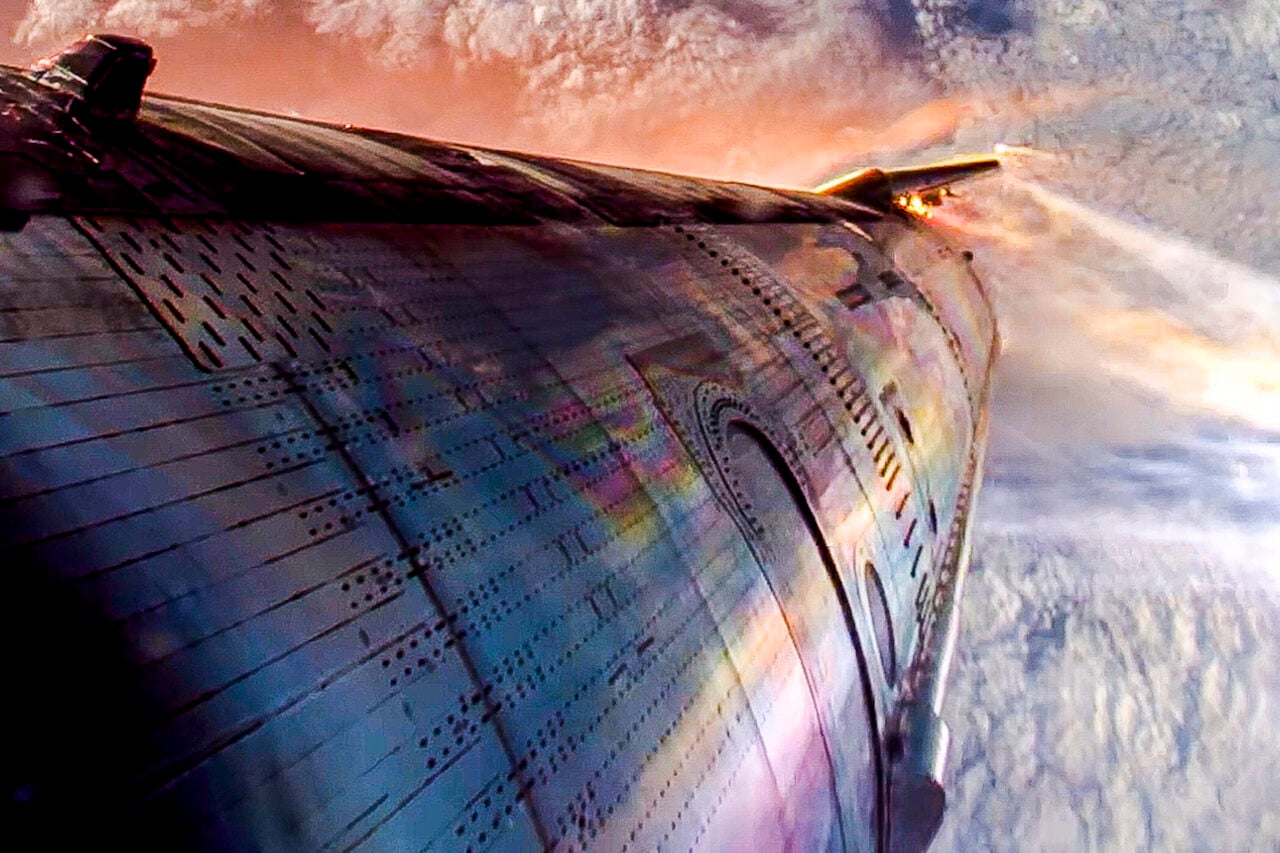
An alternative explanation is that Dr Melville-Smith was hit by a piece of space debris, such as this fragment from a SpaceX Crew-1 that landed in Dalgety, Australia, which has been known to fall over parts of the country
So far, there has only been one recorded case of a person being struck by a meteorite.
Please first to comment



Stay Connected
Tweets by elonmuskTo get the latest tweets please make sure you are logged in on X on this browser.