





 Energy




November 22, 2025
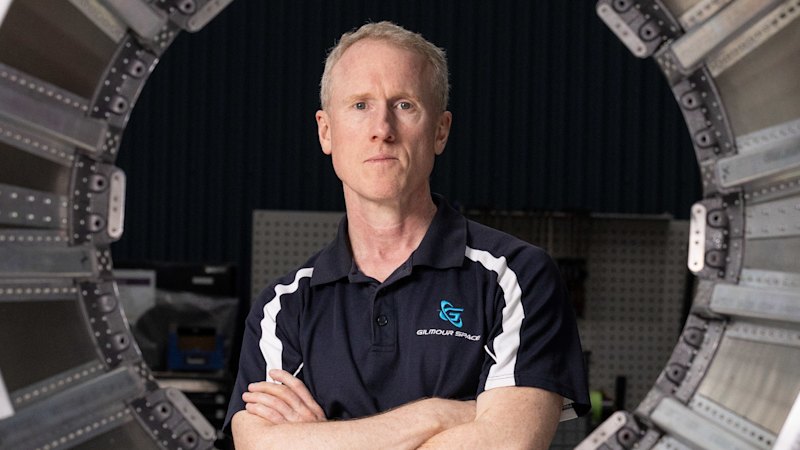
James (left) and Adam Gilmour at Gilmour Space Technologies’ HQ. “The demand [for orbital launch spacecraft] is so huge, all you need is a functional rocket and you will win,” Adam says.
Credit: Advertisement
Elon Musk started SpaceX by reading books and academic papers on rockets. Unprompted, Gilmour tells me his story “is a little bit like Elon’s”. He, too, started with books and papers he’d download from NASA’s website. He explored buying off-the-shelf rocket parts but decided it would be cheaper to just develop his own. One key difference was their technology of choice: Gilmour had become fascinated by a promising but untried Soviet rocket design – the hybrid.
The modern “big rocket” basically comes in two varieties. Solid-fuel rockets, like the Space Shuttle’s boosters, are essentially slow-burning sticks of dynamite with a nozzle on the bottom. Liquid-fuelled rockets, such as SpaceX’s Falcon, use complex and expensive engineering to mix and ignite fuel and oxygen in a much more powerful explosion.
Loading
Hybrids combine a solid fuel and a liquid oxidiser. In theory, they are cheaper and simpler to build than liquid-fuel rockets, more powerful than solid-fuel rockets, and much less likely to explode than either. “This is why people say it is the holy grail of rocketry,” says Jamie Anderson. “You can effectively start a rocket program from a light industrial shed in the middle of the suburbs.”
But hybrids pose a key technical challenge: the fuel burns too slowly. You don’t get enough thrust. No hybrid has ever achieved orbit. An American company managed to get a hybrid rocket off the pad in 1984 – and then collapsed into bankruptcy.
Yet among hobby rocketeers, hybrids have become the engine of choice because they are simple and safe. They’re less likely to blow up, hence no fireball in that vision from the day Eris crashed. Those rocketeers were an untapped pool of engineering talent, who loved space enough that they’d uproot their lives to work for someone who promised a chance at dream fulfilment. Gilmour hired some of them, and they developed a new type of quick-burning fuel and special injector, and started testing rockets in the paddocks of Gilmour’s parents’ then farm. They worked their way up from hobby rockets to upper-atmosphere test rockets (successful) then to a nine-metre rocket (unsuccessful; cartwheeled off the pad and landed nose down) and finally to Eris (the relative success or failure of which is a matter of some debate).
Eris’s July test-flight stumble was attributed to the failure of its hybrid engines, with the data suggesting the turbo pumps – that push oxidiser over the fuel grain – were drawing too much power and shut down. The fix is simple enough even though the root cause is not yet obvious, says Gilmour, who thinks the 17-month wait on the launch pad contributed. “This was an old clunker.”
The take-off is the hardest part of any launch. SpaceX’s first three rockets failed. Eris’s 14 seconds of flight time – and with the company’s guidance computers and launch infrastructure both working – mean about 50 per cent of the rocket is now flight-tested, which is why Gilmour called it a “strong result and a major step forward”. In the control room on the day itself, he was ecstatic. “As soon as we left the pad,” he says, “the company was saved.”
Not everyone agrees. A week later, in a not-so-subtle dig, Peter Beck, the CEO of New Zealand competitor Rocket Lab, told investors, “You’re not gonna hear some rubbish about just clearing the pad as a success.”
Despite admitting to some missteps, Gilmour is keen to slate maximum blame for scheduling to the Australian Space Agency (ASA), which he castigates as a bunch of risk-allergic bureaucrats. I put this to the head of the agency, Enrico Palermo, who responds by pointing out that the schedule isn’t determined solely by the regulator, but also the timely manner and nature of the information they receive from rocket companies.
Gilmour isn’t having any of it, still clearly annoyed by the refusal to green-light his launches for months on end. “When you don’t know anything you just suspect everything,” he says of the ASA. “You have a greater risk of getting hit by a meteorite than by our goddamn rocket. It was just insane.”
Adam Gilmour with Eris, which is 23 metres from tip to tail and is made of aluminium – light, cheap, easy to work with and to mass-produce.
Back in 2019, a CNET journalist visited Gilmour Space, then inside a repurposed roadside cafe, with engineering staff working around old kitchen appliances. How things have changed. It’s now a sprawling custom-built warehouse, paid for with about $50 million of private and taxpayer money. When I visit, most of the 230-odd employees have the week off to recover from the stress of the launch campaign, but the place still buzzes. 3D printers fabricate rocket parts out of plastic and an alloy developed for spaceflight. Machines to print circuit boards have just been installed. Oliwia Andrejko, who emigrated with her husband from Poland to work for Gilmour – one of many international transplants called by the rocket’s siren song – shows me the first green-grid circuit boards, which roll off the fabricator like warm toast out of a hotel buffet’s toaster. Solar cells are manufactured over here, lithium-ion batteries over there. Several technicians seem to be spit-roasting a large piece of black plastic over a fire – a process I am not allowed to know about.
I keep walking, and suddenly there it is – Eris. Laid out horizontally, in enormous stages, like the metallic skeleton of a blue whale. I’ve written about satellites and deep-space radar dishes and missions to far-off asteroids, but there is something emotionally resonant about seeing a vessel built to punch through the atmosphere. Gilmour knows how I feel. “The ground shakes, the air hits you in the chest,” he recently told a podcast. “It’s almost like you’re feeling the force of God.”
Eris is 23 metres tip to tail. Gilmour chose to build it out of aluminium because it’s light, cheap and easy to work with. That’s a mantra at the company, too, because for Gilmour to truly succeed, there can’t just be one launch. They have to achieve mass-production. Eris has to be the Model-T of rockets: you can have any colour you want so long as it reaches orbit.
“I’m on the hook for multiple rockets per annum. I won’t give you the number, it is scary, but we can definitely do it,” says head of production Matthew Halstead. As a sign of this ambition, in the centre of the warehouse, ample room has been reserved next to Eris for another rocket assembly line, maybe even three more.
Gilmour could buy in custom-fabricated metal components for the rocket’s skeleton, but says it’s actually much cheaper to buy and process cheap sheets of aluminium themselves. “One day we hope to have sheets of metal come in one end,” says Michelle, “and the rocket go out the other.”
Eris is almost ready for its next launch. Its silver bones will soon be painted with a special white ablative paint that will smoulder and fall away, dissipating heat as the rocket burns through the atmosphere. Early next year, hopefully, engineers will truck it out to Bowen, and point its tip to the sky.
Spaceflight is an extremely effective way of separating the rich from their fortunes. Richard Branson’s companies blew up an orbiter, killing a pilot, and then went bankrupt. SpaceX was literally built on the ruins of Beal Aerospace, shuttered in 2000 despite a successful test-fire and the backing of a billionaire. Gilmour has spent about $5 million to self-fund Gilmour Space (“I was well paid – and a really good saver”), and James has invested, too. So far, the company has raised about $143 million in venture capital, plus $63.3 million in federal government grants. (They are in the midst of closing another round of funding, touted at $150 million.)
Loading
On New Zealand’s north coast, Rocket Lab has built a thriving orbital launch business behind its Electron rocket. But the thinnest of margins separate success from failure. In 2022, Gilmour was waiting on a $12 million tax rebate, and the payment was delayed. The company only had enough to pay the next few months’ expenses, so he thought he’d have to lay off half his staff. Then he heard that Sam Sicilia, chief investment officer for Hostplus, one of Australia’s largest superannuation funds, was on the Gold Coast. Gilmour raced over and offered Sicilia a tour of the rocket factory. The move worked, and the fund agreed to invest. “I went from despair to euphoria in five hours.”
Gilmour has few hobbies. Mostly, he builds rockets. When things are at their worst he retreats into what he can control. He was a good-enough young gymnast to dream of making the Olympics, and that’s how he stays fit. He’s working up to competition level again, and comes out of a session on the pommel-horse and roman rings spitting fury. “I bounce the other way, and get really fiery: I will do this,” he says. “I say the ‘f’ word to myself a lot.”
Once – if – they get to orbit, the next thing Gilmour needs to do is make money so the company is viable. His company has two competitors that dominate the top and bottom of the market. SpaceX’s $US70 million rockets can carry a weight of 22 tonnes to low Earth orbit, where 90 per cent of satellites circle. Rocket Lab’s tiny Electron can carry about 300 kilograms. Eris needs to hit somewhere in the middle – and for about $US8-9 million a trip. SpaceX has a two-year backlog for satellite launches, and can’t hit the range of different orbits Eris will theoretically be able to, so the opportunity is there.
“The market is so dysfunctional now, and the demand is so huge, all you need is a functional rocket and you will win,” says Gilmour. “I don’t need a special sauce. I just need a rocket that works.”
But he needs one before he runs out of money. “Businesses like this,” says a space industry insider, “they tend to go under.”
To stay operational, Gilmour Space has diversified. In June, it successfully launched a satellite (on a SpaceX rocket). They are also developing hypersonic launch vehicles which can reach speeds beyond Mach 5. The customers? Armed forces around the world at the moment are very interested in developing hypersonic missiles, which fly so fast that they are close to impossible to shoot down. The Royal Australian Air Force is trying to build its own hypersonic cruise missile. Gilmour’s service will allow Defence to test out materials, propulsion and guidance systems at extreme speeds. “We are not building hypersonic missiles with Defence,” Michelle tells me. The Gilmour Space mission statement is, in James’s words, “all orbits, all planets, for the benefit of humanity”.
Do hypersonic flight-test services for Defence meet that lofty ambition? Recall the story of the greatest rocketeer of all, Wernher von Braun, who led NASA to the moon – after cutting his teeth developing V-2 rockets for Nazi Germany. A rocket is a rocket, no matter what’s on top.
Loading
In Adam Gilmour’s dreams, the countdown rolls. At zero, Eris combines solid and liquid fuels and, with a spark, ignites them. Gas presses out of the thrusters and against the Earth, and pushes the vehicle upwards, slowly at first but then faster and faster. As Eris accelerates, she pushes harder and harder against the air, and the air pushes back, as though the atmosphere, upset at being punctured, is trying to crush the rocket. Eventually the rocket will reach maximum speed and pressure – a moment known as “max q”. This is the rocket’s greatest test. Fail and explode. Or succeed and punch through into clear, crisp space.
Gilmour is fast approaching his own max q. It’s been nearly a decade and more than $200 million since he pledged to launch a rocket into orbit. But spaceflight is like solving a billion little problems, one after another. Every day is painful. It’s very easy, tempting even, to believe he won’t make it – that Gilmour is little more than a gnat on Elon Musk’s shoulder.
But the Gilmours are used to not being believed. They think part of this is Australia’s cultural cringe: the belief we cannot do big things. Look at our risk-averse regulator, they say, or at all the poking-fun following their first launch.
Yet an absolute prerequisite of achieving the impossible is a belief that one can achieve the impossible. And you won’t find more fervent believers than Adam and James Gilmour. “It’s almost like a religious thing,” Gilmour says. James closes our chat with a raised fist: “To the stars.”
Please first to comment




Stay Connected
Tweets by elonmuskTo get the latest tweets please make sure you are logged in on X on this browser.