





 Energy



WhatsApp
Students in the Volta Region have been introduced to foundational concepts in rocketry, satellite connectivity, and problem-solving through a Science, Technology, Engineering, and Mathematics (STEM) fair, dubbed the Durcosa Challenge, held in December 2025.
The event organised by Friends of Adaklu in collaboration with the Volta Regional Education Directorate, Our Future Prize, and Starlink for Good forms part of a growing movement to equip young learners with practical technological skills that can help them solve real problems within their school communities.
Volta Regional STEM Coordinator, Rosemary Ahiadeke, said the programme was hosted at Kpedze and Gbekor Senior High Schools for students from surrounding areas, to help reduce participation costs. She noted that more than 1,000 students benefited from this year’s edition. According to her, the purpose of the camp was to introduce basic school pupils to STEM concepts, encourage innovation, and support students in developing project ideas that respond to agricultural, energy, water, and environmental challenges affecting their schools and neighbourhoods.
Two engineers from the United States who work at SpaceX engaged directly with students, guiding them through lessons on how rockets and satellite internet work, and how good problem-solving techniques can be applied to a variety of real-world challenges.
Pupils also showcased innovations they created themselves using everyday materials to create prototype models, improve irrigation, address waste and clean water sources among others.
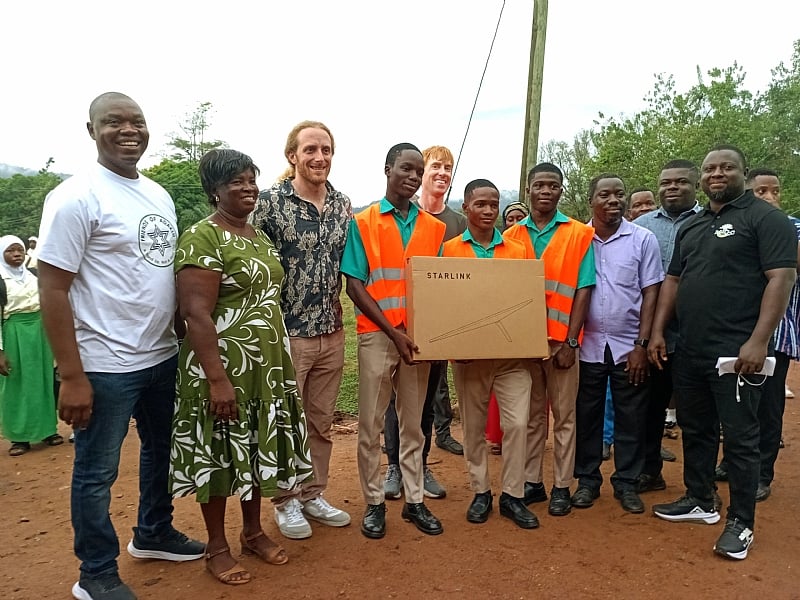
Their work was assessed by the visiting engineers, who provided feedback on potential future upgrades, and alternative solutions, sourcing components, locally, and turning classroom ideas into functioning community stations. Some of the participating schools later received Starlink Internet devices with access to one year of free data to enhance research, teaching and virtual learning.
In an interview, Ginhee Rancourt, Founder of Our Future Prize, described the Volta STEM Fair as a stepping stone toward positioning Ghana as a hub for talent development in engineering and technology. She explained that this year marked the launch of the Durcosa Challenge, which organisers hope to run annually with support from Ghana’s Ministry of Education and local STEM leadership.
Ms Rancourt also shared hopes to establish an extended mentorship platform through which learners will receive periodic guidance from global engineers via online webinars. Enabled by Starlink connectivity, students will be able to participate in virtual tutorials, career conversations, and technical demonstrations, fostering ongoing relationships with professionals beyond their local communities. “Our hope is that the young people we have met here will continue to benefit from world-class mentorship that opens doors for their future in higher education, trade, apprenticeships, and technology careers,” she said.
She added that next year’s challenge will call for higher-level innovations designed to strengthen critical thinking, perseverance, and creativity among participants. Ms Rancourt expressed appreciation for the warm hospitality received in the Volta Region and reaffirmed Our Future Prize’s long-term commitment to supporting STEM education. “We want to see these children grow into engineers, inventors, and problem-solvers who can represent Ghana on global platforms,” she noted.
Earlier this year, 57 schools across Ghana received Starlink internet devices with support from Our Future Prize. During the December visit, an additional 20 schools were connected, with approximately 180 more schools expected to come online in January 2026. Ms Rancourt explained that the collaboration between Our Future Prize and Starlink for Good aims to continue expanding connectivity in the Volta Region, while schools develop sustainability plans to maintain internet access beyond the initial free one-year connection. She emphasised that reliable internet access provides rural students with exposure to modern learning tools, enabling advanced research, online collaboration, and locally driven problem-solving.
One of the projects presented at the fair came from students of Kpando Technical Institute, who showcased an Eco-Poultry Smart Farming System model designed to demonstrate concepts that could reduce labour demands and operational stress for poultry farmers. The prototype illustrated how farmers might remotely monitor feed, water, and atmospheric conditions within poultry houses. According to the student team, many farmers struggle to track feed and water levels and are often unaware of sudden changes that threaten their birds. Their innovation, therefore, automates the monitoring and replenishing process to ensure continuous eating without manual effort.
The students explained that the proposed improvements aim to enhance farm productivity, reduce livestock losses, and minimise the physical strain farmers experience during daily operations. With further refinement and scaling, they believe the concept could support poultry farmers in both rural and commercial settings and contribute to the modernisation of agriculture in Ghana.
Educators, partners, and participants at the fair believe the innovations presented reflect the growing potential among young learners in the Volta Region. They argue that sustained exposure to STEM education, mentorship, and digital connectivity will better prepare the next generation for opportunities in aerospace, renewable energy, agritech, and other emerging fields, while also empowering them to develop practical solutions to food systems, climate resilience and development changes.
Share
Please first to comment


Stay Connected
Tweets by elonmuskTo get the latest tweets please make sure you are logged in on X on this browser.