




 Energy


Tesla's Full Self Driving is now in Europe and Steve Fowler tried it out
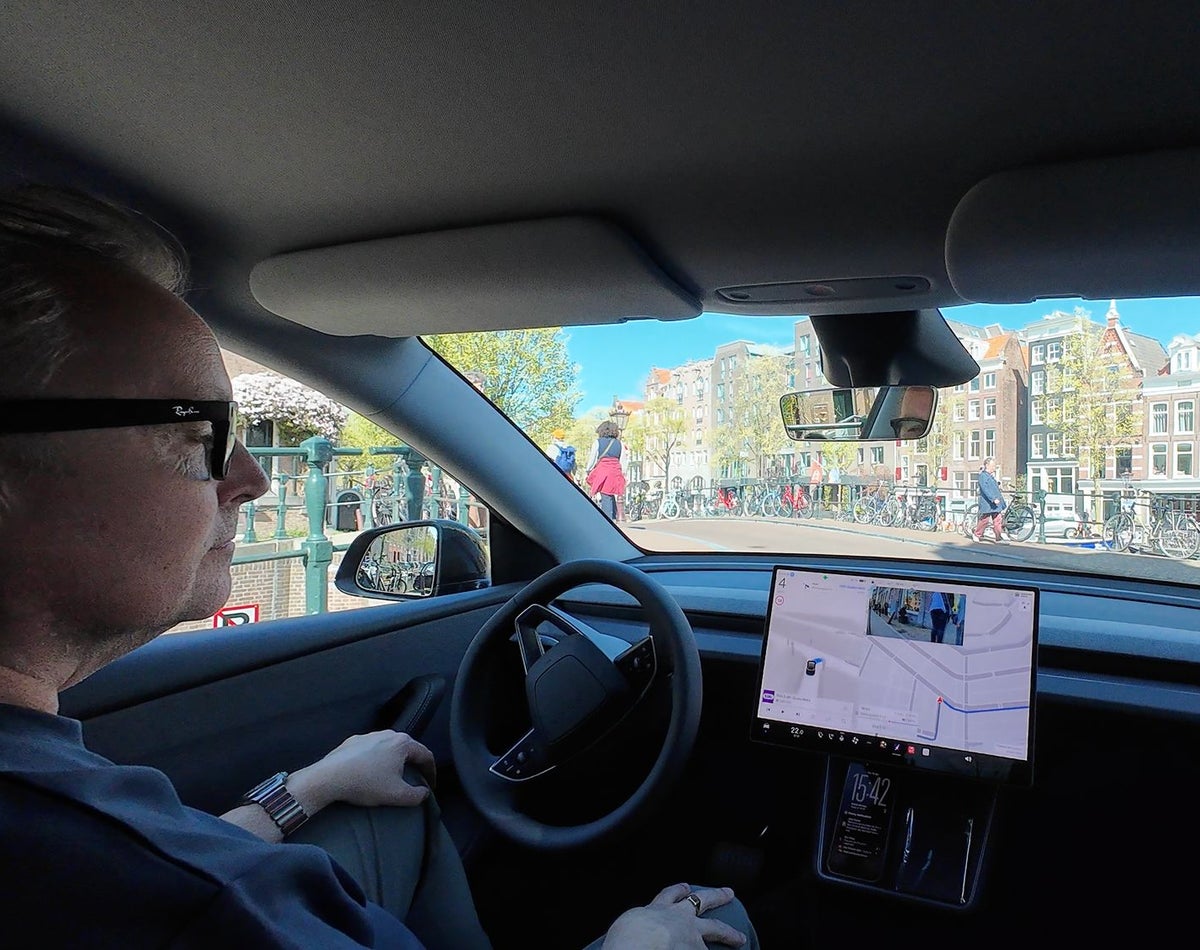
(Steve Fowler) The Tesla Model Y negotiated Amsterdam's tricky streets on Full Self Driving
(Steve Fowler)
Letâs start with how Teslaâs Full Self Driving (Supervised) works. The American company has eschewed fancy radar or lidar technology to rely on cameras â eight of them around the Model Y Rear Wheel Drive car Iâm in.
Thereâs a camera on the nose of the car, one on each wing, another in each B-pillar between front and back doors, and one in the rear. They combine with information from the carâs GPS system to pinpoint its location, and with on-board maps, microphones and gyro systems that detect the carâs movement.
All that data is fed into the carâs âneural systemâ, with Teslaâs proprietary AI then converting it into separate streams. These are then sent to the carâs steering and speed systems to produce an output thatâs designed to mimic driver behaviour.
Tesla reports that Full Self Driving users experience seven times fewer collisions on the highway, or five times fewer âoff highwayâ collisions
Clever tech is used to take account of weather conditions â including bright sunlight going straight into the cameras â while the system will even pick up on pedestrian hand and feet movement to detect which way theyâre heading, and tell if theyâre wearing headphones. The cameras do have to be kept clean and clear of obstructions, though.
Thereâs also a camera in the car â just above the rear-view mirror â thatâs watching the driver all the time. Weâve become used to cars looking at our eyes and beeping at us if weâre not focused on the road. This does that, too, but it also watches your hands to ensure you are, what Tesla calls, âhands readyâ to take over if you need to.
The Model Y I tested was happy with my hands in my lap or with my arms folded, but it started beeping when I put my hands behind my head. It would eventually cancel FSD if it thought I wasnât paying enough attention.
As Iâve experienced in the US, Tesla is learning and improving all the time. Around 198 million miles are driven every day in Teslas, with those cars all generating anonymous, aggregated data that is used to train Full Self Driving. And improvements are regularly fed into Teslas via over-the-air software updates.
open image in gallery
There are eight cameras around the car that feed data to a Tesla's 'neural system' for Full Self Driving
(Steve Fowler)
Amsterdam is a brave place to stick me in a car with Full Self Driving. If I was doing the driving, it would be challenging my full range of skills; there are just so many potential hazards to take in. The idea of letting the car do the work here is hugely appealing â although some of the stress is still there. I was constantly looking left, right, straight on and behind just in case I had to intervene.
Letâs deal with those interventions first â which were very few. A couple of times, I had to give the car a gentle reminder when it didnât spot a light that had changed to green. More importantly, I once had to step sharply on the brakes to stop going into the side of another car, but that was at a crossroads where the temporary traffic lights had stopped working. I wasnât prepared to wait and see if there was an impact for the benefit of the test â the car may have avoided it, but I didnât risk it.
The car also got a little confused over directions and road markings a couple of times, but always found another way with the navigation quickly re-routing. And on parking, good though Teslaâs self-parking system is (which is fully integrated into Full Self Driving), there were a couple of times I couldâve done it better and quicker myself, and I had to finish off putting the car all the way into a space.
Otherwise, in my hands, the car behaved impeccably. And itâs so simple to use â you set your destination on the navigation, either press the scroll wheel on the right hand side of the steering wheel or a button on the touchscreen (on older models itâs a dip of the gear selector), and with a beep, the car is in control.
open image in gallery
Tesla Full Self Driving works as well on the motorway as it does around town and will even change lanes to avoid slower traffic
(Steve Fowler)
The screen can be set to show exactly what the car is seeing â the road direction, other vehicles, traffic lights, road signs and pedestrians â and when youâre in FSD mode, thereâs a blue strip ahead of the virtual car on-screen, indicating where it intends to go. This being a car company with a sense of humour, that blue line can be changed to a rainbow-coloured road fans of a certain kart racing game will recognise.
Whatâs most remarkable is how unremarkable it all is. The car accelerates with confidence â not super-speedy but a very natural acceleration â and it corners smoothly. The car will overtake when it needs to (I was always checking the mirrors, just in case) and on occasions, it even swapped lanes approaching traffic lights when it spotted an advantage to be had â just as I would.
My Model Y never jumped the lights and was more regimented when it came to the speed limit than most other road users â so much so that it felt oddly slow on the motorway at times.
And around the busy streets of the city centre, the carâs ability to spot every single hazard and react accordingly, was hugely impressive. Had I not been using FSD, I may have been a little more strident in squeezing between pedestrians and cycles, but the impeccably mannered Model Y always gave these more vulnerable road users the benefit of the doubt.
The way the car turned sharply and cruised down narrow, cobbled streets â judging its width more confidently than I might in certain situations â was impressive
There was one slightly awkward moment when an older guy didnât know whether to cross in front of us or wait, and he looked to me for guidance. I couldnât help as I didnât know what the Tesla was about to do; in the end he just went and the car stopped. Maybe there needs to be a way for the car to send a message of its intentions to other people.
The way the car turned sharply and cruised down narrow, cobbled streets â judging its width more confidently than I might in certain situations â was impressive, too. As was the fact that the hundreds of people we passed on Amsterdamâs streets seemed to have no idea that it was the car doing the driving â although there was the odd double-take when they realised my hands werenât on the steering wheel.
With other semi-autonomous tech Iâve become used to on motorways, a journey wonât pass without me having to intervene in one way or another. I suspected that would be the case with Teslaâs FSD, too, but I was amazed at how long and how far I was able to go without intervening.
There are still particular challenges that I need to be convinced about with Full Self Driving â single track country lanes, for example. Tesla says its UK tests have involved that exact situation with an oncoming tractor thrown in for good measure. Apparently, the car simply reversed enough for the tractor to pass. But would it be quite as subservient with another car â or another Tesla using Full Self Driving? Iâm looking forward to finding out.
Recommended
Jaecoo 7 is selling fast â but should you really buy one? Hereâs my view as an EV expert
Please first to comment


Stay Connected
Tweets by elonmuskTo get the latest tweets please make sure you are logged in on X on this browser.